Direct Response Copywriting

What is value stacking in marketing and why do some offers convert effortlessly while others flop?
What is value stacking in marketing?

Why do some offers feel like a no-brainer… while others feel like a gamble?

Why does one $997 program feel expensive and another feel like it’s a steal despite the high price tag?

The difference is rarely the product.

It’s how the value is structured, communicated and layered.

This is the psychology behind value stacking in marketing, a strategy popularised by companies like Digital Marketer and often misunderstood by marketers who think it simply means “add more bonuses.”

True value stacking in marketing isn’t about adding more bonuses or content.

It’s about increasing perceived certainty that the product or service will deliver on it’s committment.

In this blog post you’ll uncover:

  • What value stacking actually is
  • A real example of how to value-stack an offer properly
  • How to do it differently for high-ticket vs low-ticket products
  • How to increase perceived value without cheapening a premium brand

Let’s start with what most people get wrong.

What Value Stacking in Marketing Really Is (And Why It Works)

Value stacking is the deliberate structuring of an offer so that the perceived value far exceeds the price.

Not through hype.

Not through fake bonuses.

But through clearly articulated, psychologically layered components that address the buyer’s internal objections before they’re voiced.

Buyers unconsciously evaluate three things when presented with an offer:

  1. Is this worth the price?
  2. Will this work for someone like me?
  3. What happens if it doesn’t?

A single flat offer answers only the first question.

A properly stacked offer answers all three.

That’s why it converts.

The Anatomy of a Properly Value-Stacked Offer

Let’s take a practical example.

Imagine you’re selling a course called:

The AI Client Acquisition System
Price: $997

A Weak Offer (No Stack) would simply be presented as:

AI Client Acquisition System – $997

That’s it.

Even if the course is brilliant, the buyer must imagine the value themselves. That’s friction.

Now let’s stack it properly.

A Fully Value-Stacked Offer would be presented as:

The AI Client Acquisition System ($997 Value)

A step-by-step system showing how to:

  • Identify profitable niches
  • Craft AI-assisted messaging
  • Build conversion funnels
  • Automate lead nurturing

As you can see, there’s already a lot of value stacked.

But now we stack on:

  1. Implementation Templates Library ($497 Value)

Not just theory but provide:

  • Funnel templates
  • Outreach scripts
  • Prompt frameworks
  • Offer positioning sheets

This increases speed of implementation.

  1. Weekly Live Implementation Calls ($1,200 Value)

Direct feedback.
Live Q&A.
Campaign troubleshooting.

This increases certainty that the support provided will increase the likelihood of a positive outcome.

  1. Private Peer Mastermind Access ($297 Value)

Community.
Accountability.
Network leverage.

This increases support and belonging so the prospect feels reassured of not being left alone if help is needed.

  1. 90-Day Results Guarantee (Priceless)

“If you implement and don’t see measurable pipeline growth, we’ll work with you personally until you do.”

This removes risk.

Add up all of this and theTotal Stated Value: $2,991+

However, the offer is being made available for just $997

Now notice something important.

The value didn’t increase because we added fluff.

It increased because we addressed friction:

  • “Will I know what to do?” Yes, because templates make it easy.
  • “Will it work for me?” Yes, because the Live calls can be used to get specific questions answered.
  • “What if I get stuck?” There’s the Community to help when needed.
  • “What if it fails?” The Guarantee reassures prospects there’s no need to worry.

That’s real stacking.

The Psychology Behind Value Stacking

Now that you understand what Value Stacking is, here’s why it works.

When buyers see a single price attached to a single item, they compare it to alternatives.

When buyers see multiple clearly defined components, their brain adds them up independently.

This reframes the purchase from:

“Should I spend $997?”

to

“I’m getting $2,991 worth of structured support for $997.”

But here’s the nuance:

It only works if each layer addresses a different type of objection.

Otherwise, it feels bloated.

High-Ticket vs Low-Ticket Value Stacking

A common mistake made by many marketers is using the same stacking strategy regardless of price.

That’s a mistake.

The psychological barriers are different.

How to Value Stack Low-Ticket Offers ($27 – $297)

Low-ticket buyers worry about:

  • Is this useful?
  • Is this practical?
  • Is this worth the impulse spend?

They are not seeking a major transformation.

They are seeking efficiency or clarity… in other words, a quick win.

So your stack should emphasise:

  • Speed
  • Convenience
  • Immediate implementation
  • Bonus shortcuts

Example: $97 Offer – Email Conversion Blueprint

Core Product:

Email Conversion Blueprint ($97)

Stack:

  • 50 Subject Line Swipe File ($47 value)
  • 10 High-Converting Email Templates ($97 value)
  • Campaign Checklist PDF ($27 value)
  • 30-Day Guarantee

Total Value: $268
Offer Price: $97

Notice that the value stack is:

Short.
Practical.
Tangible.

Low-ticket stacks increase momentum.

They reduce hesitation.

They do not require prestige layering.

How to Value Stack High-Ticket Offers ($2,000 – $50,000+)

High-ticket buyers worry about:

  • Will this fundamentally move the needle?
  • Is this worth the opportunity cost?
  • Is this provider credible?
  • Is this exclusive?

They are not buying tools.

They are buying transformation and positioning.

So your stack should emphasise:

  • Access
  • Proximity
  • Customisation
  • Speed to result
  • Risk mitigation

Example: $15,000 Business Growth Accelerator

Core Program:
12-Month Strategic Growth Framework

Stack:

  • Private 1:1 Strategy Sessions (Quarterly)
  • Custom Implementation Roadmap
  • Direct Slack Access to Senior Strategist
  • In-Person Mastermind Retreat
  • Performance Accountability Reviews
  • Revenue-Linked Performance Guarantee

Notice what’s absent:

No “bonus PDFs.”
No swipe files.
No tack-on fluff.

High-ticket stacking is about depth, not quantity.

It increases:

  • Certainty
  • Exclusivity
  • Leverage

How to Value Stack Without Cheapening a Premium Brand

This is where brands panic.

They think:

“If I start listing bonuses, I’ll look desperate.”

They’re right, if they do it wrong.

Luxury brands don’t say:

“Free bonuses worth $3,000!!!”

They stack differently.

They stack quietly.

Premium Stacking Is About Elevation, Not Inflation

Instead of “bonuses,” premium brands layer:

  • Private access
  • White-glove onboarding
  • Limited cohort size
  • Concierge support
  • Extended guarantees
  • Private events

They focus on experience and scarcity, not volume.

Example: Premium Executive Coaching ($25,000)

Wrong approach:

  • 5 bonus eBooks
  • 10 recorded webinars
  • “Free templates”

This screams CHEAP.

Correct approach:

  • Personalised 360° business audit
  • Direct access via private channel
  • Quarterly in-person strategy intensives
  • Invitation-only peer circle
  • Custom KPI tracking dashboard
  • Performance-aligned guarantee

That feels elevated.

Premium stacking increases:

  • Status
  • Proximity
  • Customisation
  • Exclusivity

Not clutter.

The 5 Dimensions of Effective Value Stacking

If you remember nothing else, remember this framework.

Every strong stack increases at least three of these five:

  1. Certainty – “Will this work?”
  2. Speed – “How quickly can I see results?”
  3. Ease – “How much effort will this require?”
  4. Status – “What does this say about me?”
  5. Risk Reversal – “What happens if it fails?”

If your stack adds components but doesn’t increase one of these dimensions, it’s filler.

The Biggest Value Stacking Mistakes

Here’s what destroys trust:

  1. Fake Dollar Values

Assigning absurd numbers to minor bonuses.

It screams manipulation.

  1. Overstacking

Too many components = cognitive overload.

More isn’t better.
Clearer is better.

  1. Redundant Layers

Five bonuses that all do the same thing.

Each layer must solve a different friction point.

  1. Stack Without Strategy

Random add-ons without psychological mapping.

Value stacking is not decoration.

It’s architecture.

Why Value Stacking Is More Important in the AI Era

Here’s the uncomfortable truth:

Products are becoming commoditised.

AI tools can replicate:

  • Content
  • Templates
  • Basic systems

What they can’t replicate is structured certainty.

That’s where stacking wins.

When everything looks similar, the offer structure becomes the differentiator.

The best marketers won’t win because their product is better.

They’ll win because their offer is clearer, safer, and more compelling.


Value Stacking Is About Confidence

When you truly believe your offer creates transformation, stacking is simply clarity.

You’re not inflating.

You’re articulating.

The buyer isn’t paying for “a course.”

They’re paying for:

  • A system
  • Support
  • Speed
  • Reduced risk
  • Increased probability of success

When that’s communicated clearly, price becomes secondary.

And when price becomes secondary, conversion increases.

Not because you manipulated perception.

But because you removed uncertainty.

That’s the real power of value stacking.



Direct Response Copywriting

Behavioural Triggers That Turn Emails into Addictive Experiences
Behavioural Triggers

Behavioural Triggers That Turn Emails Into Addictive Experiences

Every inbox tells a story, though most go unnoticed. Some messages drift past like whispers in a crowded room, easily ignored, while others arrive like a spark in dry kindling, drawing attention with a magnetic pull that almost feels unfair.

But this isn’t luck.

It isn’t simply clever copy or a snappy subject line. The emails that truly engage tap into something deeper: behavioural triggers that align with how our brains process emotion, curiosity, and identity. When you understand these triggers, you stop chasing metrics for their own sake. You start crafting experiences that readers want to enter, to linger in, and to remember.

Beyond the Click: Why Most Emails Don’t Stick

Open rates are the shallow metrics everyone talks about, but engagement, the kind that changes behaviour, tells a much richer story.

Many emails get opened briefly, glanced at, and then vanish into the mental noise of an already crowded inbox.

Why?

Because engagement isn’t about words alone. It’s about how those words intersect with the human mind. Behavioural triggers create that bridge. They guide attention without forcing it, spark emotion without overwhelming, and pull readers toward action while keeping them in control.

In short, these are the mechanisms that make an email feel alive rather than just functional.

The Attention–Emotion Loop

Your readers filter out nearly all sensory input, letting only the personally relevant or emotionally charged break through.

That’s why Apple rarely leads with discounts.

Their emails start with desire – a single image of a camera capturing golden dusk light, no caption, no hard pitch.

Your mind begins to construct the story, imagining yourself behind that lens, capturing your own perfect shot. Dopamine quietly spikes, even before you click.

This is where psychology and marketing converge. Emotion first, product second.

It’s what makes engagement inevitable.

The Anatomy of Emails That Hook

Emails that linger in memory aren’t simply informative. They deliver tiny bursts of emotional reward. Every scroll, every glance, every click is subtly guided by anticipation, delight, or the sense of being understood.

Curiosity and Reward

The human brain thrives on unresolved questions. A subject line that opens a loop “The One Mistake You’re Still Making…” triggers an itch of anticipation.

Click, and the reward resolves the tension. But the payoff must match the promise.

Airbnb excels at this balance by pairing curiosity with hyper-relevance. A subject line like “Still dreaming of your next getaway? Here are homes just like the one you saved” doesn’t just provoke curiosity; it promises a personalised reward. The brain experiences both suspense and satisfaction, creating trust while reinforcing engagement.

Pattern Disruption

Our minds are wired to seek patterns. Break the pattern, and attention snaps into focus. Glossier leverages this brilliantly, sending text-only emails after weeks of image-heavy campaigns.

A simple line like “Can we talk about skin?” interrupts expectation, pulls the reader out of autopilot, and draws them into a micro-conversation that feels intimate, human, and urgent – all without a single promotional image.

Micro-Narratives That Spark Emotion

Stories aren’t paragraphs of text but are emotion in motion. They are tiny journeys your reader can inhabit in a few seconds, yet remember long afterward. The simplest narrative structure works wonders – first, hook with desire, frustration, or curiosity; second, shift with insight, empathy, or a twist; third, reward with resolution, clarity, or transformation.

Apple’s “Shot on iPhone” campaign exemplifies this. Each image tells a story of human creativity. The product becomes secondary; the reader experiences themselves as the creator, subtly, viscerally, emotionally invested.

Emotional Archetypes That Move Readers

Contrary to what many experts tell you, people don’t act purely on logic. They act to affirm identity. Every successful email speaks to one of four archetypes, each triggering a different emotional pathway.

The Explorer thrives on novelty and curiosity. Brands like Airbnb and Notion appeal to the sense of discovery, inviting readers to uncover what they haven’t yet seen.

The Caregiver responds to empathy and connection. Calm and Headspace nurture trust and belonging, framing emails as quiet support, as though someone understands your struggle before you even articulate it.

The Hero seeks growth, mastery, and transformation. Apple and Nike tap into this archetype by inspiring confidence and possibility, making every click feel like a small act of self-empowerment.

The Rebel craves freedom and individuality. Liquid Death or Mailchimp appeal to autonomy and disruption, nudging readers to break norms, express themselves, and act boldly.

When your emails reflect these archetypes, they stop selling. They affirm the reader’s self-image, and affirmation, more than persuasion, drives long-term engagement.

Stacking Behavioral Triggers for Maximum Impact

The real skill lies in layering triggers, not applying them one at a time.

Combining scarcity with social proof works best when done with care. Scarcity generates urgency, while social proof reassures. The trick is balance: “Only 3 spots left, and every participant last quarter doubled their revenue” delivers urgency while anchoring trust. Readers feel compelled, yet safe.

Similarly, balancing novelty and familiarity creates an irresistible rhythm. Humans crave patterns but are captivated by subtle shifts. Glossier alternates tones – playful one week, educational the next – keeping readers on alert without feeling destabilised.

Timing amplifies triggers. Emails are only effective when readers are psychologically receptive. Send a FOMO message Monday morning, and stress may suppress engagement. Send it Friday afternoon, when anticipation and reward pathways are more open, and response rates can jump dramatically.

Making Emails Feel Personal, Even at Scale

True personalisation goes far beyond first names. It’s about aligning your message with how someone feels.

Casper’s abandoned cart emails do this elegantly: “Your bed misses you.” The product transforms into a small companion, not a commodity.

Voice matters too. Automation predicts behaviour but rarely feels authentic. Top brands write as if a thoughtful human.

Attentive, aware, empathic.

Composed in a way that the message was just for you.

Identity anchoring reinforces this effect. Phrases like “Founders like you know…” validate a reader’s worldview. Emails become mirrors rather than directives, subtly rewarding self-recognition and reinforcing trust.

Retention as the True ROI

Clicks are fleeting. Loyalty lasts. Behavioural triggers reach their full potential when they cultivate emotional memory – moments that linger long after the email has been read.

The brain stores emotion before logic. When emails inspire, comfort, or delight, they create memory and attachment. Minimalist Apple emails demonstrate this principle: a single line, a simple visual, yet engagement rates soar.

Listening to sentiment enhances this effect. Metrics tell what happened; emotion tells why it happened. Asking questions like, “Which email did you look forward to most?” invites readers to co-create the experience, deepening connection and reinforcing belonging.

Behavioural feedback loops further cement engagement. When readers see their past actions reflected in content, “We noticed you clicked here last time”, it signals care and attentiveness. Loyalty emerges quietly, organically, without overt selling.

FAQ

Why do some emails feel addictive while others fade away?
Because they tap into natural brain patterns: curiosity, emotional anticipation, and identity alignment. Every open becomes a small, rewarding experience.

How do I use behavioral triggers without feeling manipulative?
Focus on alignment and empathy. Triggers should enhance connection and clarity, never pressure.

Do I need a massive list to make these strategies work?
Not at all. Even small, thoughtful lists respond more deeply when emails speak to human behaviour and identity.

Which brands really master this approach?
Apple, Airbnb, and Glossier are standout examples. Each prioritises emotion over product, narrative over promotion, and human connection over automation.

Direct Response Copywriting

The Hidden Map of Your Buyer’s Mind: 8 Stages Every Coach and Consultant Overlooks


Most coaches obsess over their funnel.
“Should I run more ads?”
“Do I need a better webinar?”
“Maybe it’s the landing page…”

But the truth is, most marketing offers  don’t fail because of bad tactics. They fail because they don’t respect the journey people take before they buy.

There’s a psychological sequence that moves a stranger from “never heard of you” to “raving fan who tells everyone.” Ignore it, and your marketing feels like shouting into the void. Follow it, and suddenly everything clicks, your emails convert, your calls close, your clients stick around.

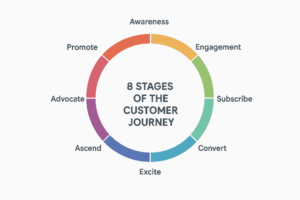
In this blog post, let’s unpack the 8 stages of the customer journey through a copywriter’s lens. You’ll see why the right words at the right time are worth more than any hack or funnel template.

Stage 1: Spark Curiosity (Awareness)

Nobody buys from you if they don’t even know you exist. But awareness isn’t just about showing up, it’s about making people care enough to stop scrolling.

The goal here isn’t to sell. It’s to enter their world with relevance and intrigue.

  • Example 1 (Coach): Instead of running an ad that says, “Join my 12-week fitness program,” lead with a hook: “Why your morning smoothie may be keeping you stuck at the same weight.”
  • Example 2 (Consultant): Rather than, “We help small businesses with strategy,” try: “3 silent profit leaks killing most consulting firms (and how to patch them).”

At this stage, your copy should whisper: “I see the problem you didn’t realize you had.”

Stage 2: Earn Attention (Engage)

Awareness gets you a glance. Engagement earns you a moment of trust.

Think of this as the “value handshake.” It’s when people lean in because you gave them something useful or entertaining.

  • Example 1 (Coach): A 2-minute Instagram reel breaking down why your metabolism isn’t “broken”, it’s just confused.
  • Example 2 (Consultant): A LinkedIn carousel showing “The 5 worst pricing mistakes consultants make (and what to do instead).”

The copy angle here? Don’t just tell, teach. People remember the brand that gave them clarity, not the one that bragged about their features.

Stage 3: Invite Them Closer (Subscribe)

Now you’ve earned interest, you ask for a small commitment: an email, a follow, a DM. This isn’t about the “lead magnet”, it’s about the promise behind it.

  • Example 1 (Coach): “Download my free 7-day reset plan” isn’t just about the plan, it’s saying, “I can guide you through transformation, step by step.”
  • Example 2 (Consultant): Instead of, “Grab our whitepaper,” frame it as: “The $50K mistake most small businesses make in year 2, here’s how to avoid it.”

Copy at this stage needs to answer: “Why should I trade my attention for your guidance?”

Stage 4: Build Trust Through Action (Convert)

This is where people stop being “leads” and take their first real step—often a small purchase or a booked call.

The key? Reduce friction while amplifying urgency.

  • Example 1 (Coach): A $27 mini-course on “How to finally enjoy your workouts” that makes the full $2,000 program feel like a natural next step.
  • Example 2 (Consultant): Offering a “90-minute strategy audit” for a small fee that leads seamlessly into a longer engagement.

The copy needs to bridge belief: “You’ve tested the water, it’s safe to swim deeper.”

Stage 5: Deliver Delight (Excite)

This stage is where most businesses lose momentum. The first paid experience sets the emotional tone: disappointment kills, delight multiplies.

Copy isn’t just for sales, it’s for reaffirmation.

  • Example 1 (Coach): A welcome email that says: “You didn’t just join a program. You joined a movement of people who refuse to settle for burnout.”
  • Example 2 (Consultant): An onboarding document that says: “By the end of this week, you’ll see the three quick wins we’ve identified for your business.”

Here, words reinforce the decision. You want clients thinking: “Yes, this was the right choice.”

Stage 6: Elevate the Relationship (Ascend)

Once you’ve earned excitement, the next natural step is to offer something deeper. This isn’t “upselling.” It’s advancing their transformation.

  • Example 1 (Coach): Moving clients from a group program to one-on-one coaching with messaging like: “You’ve mastered the foundation, now let’s tailor it to your exact goals.”
  • Example 2 (Consultant): From a one-off audit to a 12-month retainer framed as: “The audit fixed the leaks. Now let’s scale the revenue.”

The copy should show: “The path doesn’t stop here, it gets even better.”

Stage 7: Turn Clients into Storytellers (Advocate)

At this stage, people love what you do. But love doesn’t automatically turn into advocacy, you have to make it easy to share.

  • Example 1 (Coach): Highlighting a client story in your newsletter with the line: “Maria dropped 12kg, but what she really gained was confidence to dance at her daughter’s wedding.”
  • Example 2 (Consultant): Sharing a testimonial video that begins with: “We were stuck at $400K revenue… until this one shift doubled our pipeline.”

Copy here should act as a mirror: reflecting the client’s success so they feel proud to share.

Stage 8: Build Raving Fans (Promote)

Advocacy is passive. Promotion is active. This is when clients start bringing people to you because they believe in your mission.

  • Example 1 (Coach): A referral program framed not as “Get $100 if your friend signs up” but as “Help a friend finally feel the energy you’ve discovered.”
  • Example 2 (Consultant): Turning clients into co-creators: “We’re building a private roundtable of our most successful clients, want to bring someone you trust?”

Copy here should appeal to identity: “By promoting this, you’re part of something bigger.”

Why This Map Matters

Most businesses only write for Stage 4 (Convert). That’s why their marketing feels like it’s always pushing.

The real money, and more importantly, the real trust, comes from writing across all 8 stages. Different stages demand different tones: curiosity, clarity, confidence, celebration.

When your copy respects the journey, strangers don’t feel sold to. They feel guided.

If you’re wondering where your emails, landing pages, or offers might be silently leaking revenue… drop me an email. I’ll do a quick review and show you which stage is costing you the most.


Direct Response Copywriting

6 Steps to Writing Copy that Maximizes ROAS on Facebook Ads

Are you looking for ways to optimize your return on ad spend (ROAS) on your Facebook Ads?

Writing effective copy for your Facebook Ads is critical for ensuring that your ad campaigns are successful.

Here are seven simple steps that you can follow to write copy that maximizes your ROAS.

Let’s get started!

Understand your target audience
As any experienced digital marketer knows, understanding your target audience is the key to successful Facebook Ads campaigns.

To maximize your Return on Ad Spend (ROAS) on Facebook Ads, you first need to identify who your target audience is, what their needs are, and what language resonates with them.

Conducting market research is the best way to get to know your potential customers. You can use surveys, focus groups, competitor analysis, or other research methods to gain insights into your target audience’s needs, interests, and preferences.

This will help you to tailor your messaging to their needs and create copy that resonates with them.

Once you have identified your target audience, you can start to craft compelling copy that speaks directly to them. Think about what messaging points are most important to emphasize and what value your product or service can offer. Use clear and concise language that is easy to understand and drives them to take action.

Don’t be afraid to experiment with different copy variations to see which ones perform best and maximize your ROAS on Facebook Ads. Try different types of tonality, lengths of copy, offers, and calls to action to see which ones are most effective with your target audience.

By understanding your target audience and creating copy that resonates with them, you can maximize your Return on Ad Spend (RoAS) on Facebook Ads and get the most out of your campaigns.

Set clear goals for your ad
Be creative with your copy. It’s important to stand out from the competition and be creative with your ad copy.

Defining the goal of the campaign will help you determine the key metrics you should be tracking, such as impressions, clicks, and conversions. This will also help to inform the ad copy you create and ensure it’s aligned with the goal of the campaign.

Craft an attention-grabbing headline
Creating an engaging headline is an essential step in writing effective copy for Facebook Ads. Your headline is the first thing readers will see, and it’s often the deciding factor in whether or not they will engage with your ad.

Here are some tips for creating a headline that will maximize your return on ad spend (ROAS).
1. Craft a headline that resonates with your target audience. Take the time to do market research and find out what resonates with your target audience. Think about their pain points, interests, and challenges. Use these insights to create an eye-catching headline that speaks to their needs.
2. Include a call-to-action in the headline to encourage readers to take action. Invite readers to learn more, click through to your website, or take advantage of a special offer.
3. Leverage keywords in your headline to make it more search engine friendly. Using keywords related to your product or service will help your ad show up more often in search results.
4. Make sure the headline is succinct and captures the main message of your ad. Keep it short, sweet, and to the point. Avoid using jargon or overly technical language that your audience won’t understand.
Creating an effective headline is just one of the many steps you need to take to ensure that your Facebook Ads will be successful. With the right strategy and copy, you can maximize your ROAS and reach your goals.

Create compelling body copy
When it comes to writing copy that maximizes your return on ad spend (ROAS) on Facebook Ads, there are a few key steps to follow.

Research the interests, needs, and pain points of your ideal customer to ensure your ad copy is tailored to the specific audience you’re targeting.
Once you have a clear goal and understand your target audience, it becomes easier to craft the copy.

Once you’ve identified your target market and their motivations, it’s time to craft a message that speaks to them. Make sure your copy is clear and concise, and communicates the value of your offer in a way that will compel them to take action.

Structure your copy to draw attention. Consider using headlines, bullet points, and bold text to make your copy stand out.

It’s also important to ensure your copy is aligned to the offer on your landing page. If there’s a mismatch, your prospect will get confused and your conversions will suffer.

Use eye-catching visuals
The right visuals grab your audience’s attention and make your ad more engaging. Try to use visuals that are relevant to your message and that will appeal to your target audience.

Be creative. Try to think outside the box and come up with unique visuals that are eye-catching and relevant to your ad copy.

Add a strong call-to-action
A strong call-to-action is a crucial step to maximizing your return on Facebook ad spend (ROAS). It can mean the difference between a successful ad campaign and one that falls flat.

Your call-to-action does the same job as a salesperson who has just finished making a presentation and is asking for the sale.

Add a sense of urgency. Include phrases like “limited time offer” or “hurry before it’s too late”  to create a sense of urgency and get people to act quickly.

Test your ad

Ultimately it’s the market that decides which copy will convert the best. Test different versions of your copy to see which one resonates with your audience and yields the highest ROAS.

Adjust your ad copy to maximize conversions for each segment targeted in the ads.

Here’s a summary of the steps for crafting copy that maximizes ROAS on Facebook Ads:

1. Identify your target audience and create a buyer persona. Before you can begin writing your ad copy, you need to know who you’re writing for. Take the time to define your target audience and create a buyer persona. This will give you a better understanding of their needs and wants, which will help you craft more effective ad copy.
2. Analyze the data and break down your target audience into segments. Once you’ve identified your target audience, break them down into smaller segments. Analyze the data and use it to craft customized messages for each segment.
3. Develop a unique voice and tone for each segment. Every segment of your target audience should have its own unique voice and tone. This will help ensure your ad copy resonates with each individual segment.
4. Understand the psychology behind each segment’s buying decisions. Once you’ve identified your target audience and developed a unique voice and tone for each segment, it’s time to dive deeper into their buying decisions. Try to understand the emotional, psychological, and practical reasons why each segment might be interested in your product or service.
5. Create ad copy that speaks to each segment’s needs and wants. Now that you have a better understanding of each segment’s buying decisions, you can craft ad copy that speaks to their needs and wants. Make sure to use language that resonates with each segment and appeals to their emotions.
6. Test different versions of the ad copy and track results. Once you’ve crafted your ad copy, it’s time to test different versions and track the results. This will help you determine which version resonates best with each segment and maximize your return on ad spend (ROAS).
7. Adjust your ad copy to maximize conversions for each segment. Finally, use the data you’ve collected to make adjustments to your ad copy.

Follow these steps to maximize conversions for each segment and get the best results for your Facebook ad campaigns.


Direct Response Copywriting

Landing Page Videos – Do they Always Work?

Do Videos in Landing Pages Always Work

Landing page videos. Do they work? Whether you’re on LinkedIn, Facebook or your other favourite social media, there’s no escaping videos. Of course it makes sense to use videos. With attention spans getting shorter, it’s so much easier to consume content in an  audio-visual form instead of reading a long page of text.

From a content consumption point of view, people have different preferences. The auditory prefer to listen, the kinaesthetic like to read and the visual prefer images and video. Besides, video appeals to both the visual and auditory senses.

In the early days of the internet, inserting landing page videos, videos in blog post or articles was an arduous task. Nowadays it’s as simple as recording a video, making simple edits and uploading it to a blog or social media channel.

Most internet marketing gurus will tell you that you really must use landing page videos, or vidoes when creating online content.

The question is, will the strategy of using landing page videos work all the time?

To find out if landing page videos work, here’s an interesting case study.

Recently I crafted the content for a landing page promoting a business breakfast event at $27 per attendee. The target audience for the promotion was business owners who were already investing in online marketing but weren’t getting the desired return on investment.

The pain point which the landing page focused on was the dynamic state of the internet and the difficulty in keeping up with what was really working in 2016.

 Headline for the landing page:

Landing page videos headline

The content had all the elements of persuasive copywriting including bullet benefits, price justification and a strong    call-to-action.

The following is a snapshot of the bullet points:

Landing page videos bullet point

Price justification plug:

Price justification image

Traffic to the landing page was generated through paid advertising on Facebook and through a series of emails sent to the database.

Facebook ad used to drive traffic to the offer using audience insights.

Facebook ad image

The target of 15 registrations was achieved in the first 5 days of the the landing page going live.

The event itself was an eye-opener for many of the attendees, some of whom were more than willing to record video testimonials and give permission to use these to promote future events.

An encore presentation was planned the following week to meet added demand and accommodate prospects who had booked for the previous event but could not be accommodated due to capacity constraints.

This time it was decided to add the video testimonial as a proof element since it was specific to the event. Once again Facebook ads and email marketing were used to drive traffic to the landing page. Apart from the additional video testimonial, the landing page remained unchanged.

The result…

There was a marked drop in the registrations. A decision was made to split test two landing pages…one with landing page video and the other without the video.

Surprisingly the landing page without the video testimonial, converted 10 times better than the one with the landing page video.

So, does this mean that you should not use video in landing pages or sales pages?

Far from it. The lesson here is, despite what the hot shot digital marketing gurus have to say about video marketing, there’s no guarantee landing page videos will increase conversions. It could just be that your prospects get distracted by watching the video. They momentarily forget why they were on the landing page and may have left.

Rather than discard the video testimonial completely, it was put to good use in a broadcast email to the database for promoting the next event

Sub: Lead Generation Breakfast…What You Missed + Second Chance

 Just thought I’d give you an update on yesterday’s Lead Generation Breakfast where Eleven Lucky Business Owners discovered exactly what’s required to generate leads online and achieve double digit growth in 2016.

The highlight of the event was the hot seat, where one lucky business owner had their online business strategy scrutinised in microscopic detail. What emerged from the hot seat were strategies and tactics which were an eye opener…worth ten times the investment made to attend the event.

Unfortunately, you weren’t able to attend. So we recorded a video to show you what one business owner thought about the event.

Click Here to Watch the Review

Now for the good news.

We’ve decided to run the event again on the 25th May 2016.

There are two reasons why we’re doing this.

A few of you registered after we had closed the bookings and expressed your disappointment.

Conflicting schedules made it impossible for some others to attend.

We totally get it…and we want to make to make it up to you.

So, we’re having an encore.

<>

Spaces are limited, so please act quickly.

<>

Best regards

(Signature)

P.S. Business owners who expressed an interest for the earlier event will be given priority, and by the time you receive this email those seats will be taken up. To book one of the remaining seats please book early to avoid disappointment. Click Here to reserve your seat.

The email had high open rates and click through to the landing page promoting the encore Lead Generation Breakfast…

…which leads to an important aspect of online marketing.

This important aspect is one which you cannot ignore even for a day if you want your business to grow. As you may have guessed it is tracking and measuring everything you do using tools such as Google Analytics.

Track the Performance of Your Website and Spy on Your Competitor’s Site

This invaluable tool will help you to track your analytics and also spy on competitor sites.
Check it out. It has a lot of other features as well, including a website malware checker.

Yes. I would like to know more about this website performance measurement tool.

If you use landing page videos, make sure you split test your pages by using enticing images in one and a video in the other.

It’s the only way you will know what works for your market. As I always say, only the market can decide what they want. When you feed your market what they want, you will reap the benefits and your sales will soar.

 If you would like to accelerate sales for your business using killer copywriting and marketing strategies, email co*****@*****************ts.com with details of your website and what you want to achieve. There’s no charge and is obligation-free. This offer is for serious business owners, who already invest in marketing and advertising.


Direct Response Copywriting

Three Copywriting Clicks to Move Prospects from Fear to Trust

Copywriting clicks

One of the most common copywriting mistakes made by marketing strategists when is an overriding focus on product features in their advertising messages. Strange as it may seem, it’s not really your “product”, the prospect is after. What your prospect is really seeking is a solution to a problem or a means of satisfying an immediate want or need. Your product or service is only a medium to achieve either of these objectives.
This being said, the question you should be asking yourself is, “Why should a prospect choose your product or service over your competitors?” The answer is not in how great your product or service is. The right answer is how in their mind your product or service will help the prospect overcome a problem or satisfy a want or need better, faster and with the least amount of effort than your competitors.
Understanding this principle will make the difference between the success and failure in your marketing going forward.
It was Robert Collier who said, “You must enter the conversation already going on inside your customer’s mind.” Once you know what their fears, frustrations, needs and aspirants are, crafting compelling copy for your advertisements and sales material becomes simple.
When you first engage with a prospect either in person, on the phone or through the media it’s only natural you’ll be up against a wall of mistrust. A number of questions are running through a prospect’s mind: “Will I get ripped off?” “How will I pay for this?” “Will the product last long?”
So how do you take the prospect from a position of fear and mistrust to placing their trust in you when crafting compelling copy for your sales material?
A quick and easy way to do this is by using three copywriting clicks that have been proven to succeed.

1. The Enemy In Common Copywriting Click

Enemy in Common Copywriting Click

Identifying a “common hate” that consumers feel with a product or service and using it in your copy can help you gain immediate trust. The secret is to acknowledge the pain and empathize with your prospect. For instance, lawyers specializing in helping people achieve a positive outcome when making insurance claims can use large insurance companies as the enemy in common.
The headline for a sales letter can read:
“A Distraught Single Mother Reveals How She Fought Back to Get Compensation When Her Claim Was Denied By a Ruthless Insurance Company…and How You Can Do the Same.”
The body copy would go on to build empathy with the reader, explaining how insurance companies make it a practice to decline claims as far as they can, the lawyers know how it feels to be victimized…and how they can help. Let’s move on to the next copywriting click.

2. The Shared Values Copywriting Click

Shared values copywriting click

When crafting compelling copy, it’s important to know that people buy from those they like and trust. Try and find some common ground between you and your prospect. For example if members of your target audience reside in a local suburb in which your contribution has been publicly acknowledged, then don’t make this your best kept secret.
Use blurbs or boxes in your sales copy to indicate who you support or even write a paragraph explaining the extent of your contribution to the local community. Using clippings of press coverage or a snippet of a TV interview can help to authenticate your claim.
You can go further and pledge a portion of your sales to a noble cause or project in your local area, such as contributions to a school seeking funds for constructing classrooms.

3. The Empathy Copywriting Click

Empathy Copy click

If you’ve done your research thoroughly,you should know what’s going on in your prospect’s mind. Showing empathy to your prospect can immediately lower the barriers to building trust. Explain how you’ve been in a similar situation which is why you understand the pain experienced by your prospect.
For example if you’re selling accounting software your copy can read…
“…despite exceeding sales targets, you just can’t explain why you’re not achieving profits. Two years ago I was in exactly the same situation. My crack sales team easily achieved their targets, yet the profits weren’t rising. I was puzzled and completely at a loss.
It took me three months and $150,000 to discover exactly why I wasn’t making huge profits despite achieving record sales. It was a flaw in my accounting system. So I decided to do something about it. Six months of development, testing and $40,000 later I had a software solution able to pick up even the slightest flaw in the accounting system. Now my business is turning over six figures every year and my accountant has never been happier.
But enough about me. Now I’d like to help you achieve the same results…”
If you’re ever stuck for ideas when writing copy, try these tactics the next time you’re writing a sales letter or creating online content. First find out what’s going on in the mind of your prospect and then see how best you can use one or all of these copywriting clicks to move your prospect from fear to trust and get the cash register of your business ringing.

Direct Response Copywriting

Has the Unique Selling Proposition (USP) Concept Lost It’s Long Term Potency?


Pizza hut


The term Unique Selling Proposition or USP as it is commonly known, was introduced in the 1940s by adman Robert Reeves. The purpose of a USP was to convey a unique benefit about the product or service to the target market which was not being offered by competitors.

One of the most famous examples of a USP is Domino’s Pizza – “Fresh, hot pizza delivered in 30 minutes or less guaranteed!” This slogan turned a struggling enterprise into a global success.

FedEx, the internationally reputed courier company is another business which drew strength from its USP, “When it absolutely, positively MUST be there overnight”. On the strength of that message, they created a delivery business dynasty.

The question you may be asking is, “So why have both these organizations stopped using their unique selling proposition today? There are several reasons who this happens – the competition steps up their game, the needs of the marketplace changes or it’s no longer practical to make the claim. Dangerous riding by Pizza delivery scooterists desperate to deliver Pizzas in 30 minutes could lead to an increase in accidents. Apart from the media having a field day, escalating insurance costs would mean the numbers don’t justify continuing with the proposition.

The Leveling Power of the Internet

The internet has been a game changer in the way businesses compete to get a share of their prospects mind. Apart from the speed of bringing a message to the market, the costs are strikingly competitive compared to traditional media. In fact, it’s often said that the internet is the cheapest place to fail. A USP can be annulled by competitors countering the unique benefits claimed, by their own renditions or even a slight alteration to the original claim.

The phenomenal growth of the internet has seen a mushrooming of copycat businesses. Even if a business develops a product with unique benefits, spends months researching the market and invests a small fortune in branding and creating a slogan that’s an attention grabber, it’s unlikely the company will be able to rest on its laurels for long. It doesn’t take long for a wannabe competitor to come along with a “me-too” product so the USP painstakingly communicated to the target market quickly loses its uniqueness.

The Curse of Instant Gratification

Technological breakthroughs combined with easy access to products and services through the internet has spawned a culture of instant gratification. This results in rapid shifts in demand. At times such shifts can happen suddenly. If the market loses interest in the product category a USP, however strong, instantly loses its potency. How many people today buy their own cloth and visit a tailor to have clothes stitched when they can walk in and walk out of a store with a new set of clothes?

Building Trust and Lasting Relationships

 Consumers today are having it tough and are reigning in their expenses. On the other hand there has never been a wider choice of products and services to choose from. It’s why retail stores are losing sales to online giants like Amazon as shoppers compare prices in the store and have no qualms walking out of a store empty-handed but with their order completed online.

It’s a well-known fact that people buy from those they like and trust. It’s why businesses like McDonalds, Pizza Hut and others have outlasted competitors who have quickly faded away. As a customer you know exactly what you get, anywhere in the world. Trust, familiarity and personalization are reasons why micro businesses you may never have heard of thrive for decades. They take pains to nurture their customers and treat them like friends. Eventually their customers become raving fans. Legendary rock bands like the Rolling Stones and football teams like AC Milan are proof this strategy works. They build relationships with their fans that often last a lifetime.

While this may fly against what the marketing experts tell you and it does not rule out differentiating your product or service, there is a fundamental shift in thinking required to succeed in business today. A USP is important, however its importance has been usurped by the need to build trust and establishing relationships. In an untrusting world this isn’t easy. However, the benefits are long lasting and ascend customers to becoming raving fans. Strong and stable relationships stand the test of time and aren’t easily eroded by the new kid on the block, seemingly appearing out of nowhere with a shiny new product attempting to get loyal customers to defect.


Direct Response Copywriting

The 5 Step Lead Generation System for Higher Sales Conversions

Whether you’re finding it hard to get qualified leads or finding it difficult to convert them to paying customers, wouldn’t it be great to have a proven lead generation system you could use to attract qualified leads, eliminate tyre-kickers, convert prospects to clients and make a tidy profit even after they’ve bought your highest value product? You can do all of this without making a single cold call and replicate the process over and over again easily and for a lot less than it would cost you if you continue using traditional marketing methods.

This system is built on the fundamental principles of growing a business. These are:

1. Increasing the number of customers or clients who buy your products or services

2. Increasing the average dollar value of the transaction for every customer

3. Increasing the number of purchases made by each customer

If you have ever bought a domain name from Go Daddy or a book from Amazon, you’ll understand exactly what I mean. They don’t let you get off with just a domain name purchase or buying one book, do they? There are always add-ons offered before you get to check-out. In the case of Amazon, it may be books on a related topic others have bought. Go Daddy will offer you domain names with different extensions such as dot mobi or dot net, hosting for your website and will also try and lock in your domain name purchase for a longer duration of 3 to 5 years.

So let’s see how you can fit these three lead generation fundamentals to create a sales funnel which generates leads you can easily convert into sales and feed their hunger even if you have nothing more to sell.

Step#1

Create a Lead Grabber

The first principle of growing your business is to increase the number of customers or clients who buy your products or services.

A simple way to do this by creating a lead grabber. Most of you may already be familiar with this step. As the name implies, the purpose of a lead grabber is to grab the contact details of prospects in exchange for providing some valuable information such as answering a perplexing question to something that’s been bothering them. As many of you may have guessed, the most common form for this lead generation tactic is providing the information in the form of a free report.

Here are a few ideas for you.

Tourism

Top 10 Favourite Destinations in New South Wales

What Perth Locals Enjoy but Don’t Want You to Know

Business to Business

10 New Winning Social Media Strategies for 2014

Donald Trump’s Secret Strategy to Keep Your Business from Going Bankrupt

Dental

7 Days to Stain Free Teeth

10 Habits for Longer Lasting Teeth

Chiropractors

7 Simple Exercises to Get Rid of Chronic Back Pain

Elite Athletes Secrets to Keeping Back Problems at Bay

Legal

Will You Win? Questions You Must Ask Your Attorney!

Top 50 Confusing Terms You Should Understand Before Hiring an Attorney.

The most common method of generating leads this way is to have an opt-in form on your website, so visitors fill in their name and email address in exchange for the information. Alternatively you can publish a small black and white ad where prospects can call a number to order the report, fill in a form and mail it to you or the ad can direct them to a landing page.

Step #2

The Tyre-Ticker

Once you’ve set up a landing page for your Lead Grabber and drive traffic to the page, you will find your auto responder quickly fill up with names and email addresses of prospects. The sad truth is that many of the website visitors who opt-in will never buy from you. At this stage you still have not qualified your leads. Many marketers waste time and money on email campaigns targeting their generic list without segmenting the leads.

The question is, how do you know which of the leads generated will convert to sales?

There is a simple and effective way to do this. It’s called the tyre-kicker offer. A day or two after prospects sign up for the free report, offer them another product which is of high perceived value. This time, instead of offering it for free, charge them a small fee, low enough to make the purchase a no-brainer.

Why do we have this low-priced offer? This is how we separate the serious prospects from the tyre-kickers. If prospects aren’t willing to part with a measly $7 to $20, what chance do you think you have doing business with them?

Of course, it goes without saying that the offer needs to be so attractive and affordable that it’s hard to resist.

This step is the key difference to creating your sales funnel in 2014. Make sure you don’t miss this step as it could save you thousands of dollars in marketing costs by eliminating the tyre-kickers from your marketing funnel.

Now you can focus on prospects who are really serious… people who have already invested money with you. You may wish to move these buyers into a separate list in your auto responder as the next part of the funnel will focus on them.

Step #3

The High-Ticket Offer

If you’re probably wondering how you will turn over a profit with a $7 to $20 product, the answer is you don’t. The only reason you’re making this offer is to acquire a customer. Although you haven’t made any money yet, you’ve started the process of building a responsive list of buyers.

You should already have a High-Ticket Offer, your Cash Cow product or service which is the backbone of your business. How much easier is it to sell your High-Ticket offer to customers who have gained immense value from your tyre-kicker offer? By this time they would be virtually begging you to sell them something. The tyre-kicker gave them a taste of what’s to come. The High-Ticket Offer feeds this hunger.

You’re now attempting to get buyers of your Tyre-Kicker offer to make a big leap of faith and invest in your High-Ticket offer, which could be in the $297 to $497 price point or in a price bracket that’s relevant to your industry. To get them over the line, this is where you pack in the proof in the form of testimonials and case studies. Reversing the customer’s risk by offering a no-holds-barred guarantee also helps in getting those teetering on the edge to cross over the line.

Step#4

The Platinum Profit Maker

Now you’ve got the customer to place an order three times. You’ve got them excited and many are raving fans. They’re hanging on to your every word and want more. It’s time for the Platinum Profit Maker, your top-of-the range offer for customers who are really committed and are willing to do what it takes to succeed. These are the customers who will become your raving fans and promote you like crazy.

It is worthwhile mentioning here that a part of the profits you make from your High-Ticket Offer should be invested in promoting the Platinum Profit Maker. You need to pull out all the steps in presenting this offer using webinars, video sales letters email marketing and even direct mail. Your prospects consume information in different ways – Visual, Auditory and Kinesthetic, so appeal to all the senses in getting your message across effectively.

The tactics you need here are exclusivity and takeaway selling. Your pitch should focus around exclusivity and restrict the offer to a select few customers and that too by application only. You need to create the impression that it doesn’t matter to you one bit if customers don’t take up the offer because the supply is limited and it’s not for everyone.

The goal in step is to increase the average dollar value of the customer, the second principle of growing a business.

Step #5

The Relationship Path

The goal of this step is to increase the number of purchases your customer makes over the life of your business relationship. This is the third principle for growing a business.

Die hard sports fans remain loyal to their teams for decades, often for a lifetime. They follow every game and some fans can reel of statistics of their favourite players to impress their friends.

You want to create the same kind of relationship with your customers. Some may have consumed all your material, taken action and achieved results. Others may have bought into your offers but not yet taken any action with the material. In either case, now you’ve established yourself as the expert; for fear of missing out on what’s new in the market, they have an insatiable desire to learn more from you. It’s your job to keep feeding them with information and products.

This is where affiliate marketing can be used as a nice earner if you’ve exhausted all your products. An email blast promoting someone else’s product, relevant to your niche can generate instant cash flow. As your list of subscribers grows you can approach other businesses with large lists to promote your products, if you agree to promote theirs.

The key to success here is to constantly feed your subscriber list with information and offers. Send them emails at least once a week. Get them to join your Facebook groups and YouTube channel, follow you on twitter and connect on LinkedIn. The more touch points you have the greater your influence in the market.

This is the exact lead generation system which can be replicated in any business to achieve staggering profits. It’s simple and can be easily applied to help your business grow exponentially in any economy.

If you enjoyed this article and would like more details about building an automated lead generation system, Click Here to get Free in-depth lessons which explains the process in more detail.

Direct Response Copywriting

Social Media Copywriting – A Nightmare For Copywriters?

The average consumer is bombarded with a zillion advertising messages every day. Getting past the filters that allow only a trickle of messages to penetrate through to the subconscious mind of consumers is the challenge that copywriters face every time they begin to write copy. If that wasn’t difficult enough, along comes social media to present a fresh new challenge. How should copywriters craft a message that cuts through the clutter and whacks readers with an attention grabbing message that not only gets read, but is commented upon, re-tweeted, shared or liked?

Social Media copywriting requires a new way of thinking – unlike writing copy for advertisements that sing the virtues of the latest model car or children’s shoes. Business related content posted on social media sites competes with snippets of information about celebrity news, photos of last night’s party bash and trending topics that are of specific interest to individuals. It’s almost like learning how to write copy all over again – short staccato bursts that whip through the social media ether and shoot through to the reader’s consciousness.

Social media copywriting – From thinking about the big idea to thinking keywords

Social media Copywriting is not about enticing a reader through a long drawn story that appeals to the deepest desires of the prospect, hopefully leading to a purchase. The internet is powered by search. That’s exactly why Google has become the generic word for search engines. Only about 15% of users use the internet with the intention of buying a product or service. That’s why keyword research is regarded as pure gold in search engine optimisation. This is what copywriters need to focus on for social media copywriting. Headlines for Facebook posts and YouTube videos need to be keyword rich. Twitter posts should include keywords or keyword phrases, so they are found.

Social media Copywriting – From writing prose to writing headlines

In traditional ad copy, copywriters have the luxury of quarter, half-page or even a full page of a newspaper or magazine. Ample space to excite, cajole, lure or scare the reader into taking action. With social media copywriting it’s all about a keyword packed punchy headline. Get this wrong and the eyeball flicks off the content in a nanosecond and onto whatever else grabs the attention of the reader. Short keyword rich posts that pack a punch is what’s needed in social media copywriting to cut through the heap of garbage that clamour for the reader’s attention. Of course with platforms like Twitter, there simply is no other choice. With a limit of 140 characters, Twitter posts are simply power packed headlines disguised as posts. Anything wimpy gets passed over in the blink of an eye.

From One-Way communications to Viral Conversations

Social media has leveled the playing field like never before in the history of marketing communications. Traditional media allowed businesses to have the field to themselves. Consumers had no voice, and simply had to accept what was written or spoken in the ad as the gospel truth. Social media allows complete freedom of expression, and consumers can finally talk back to businesses about their products and services. Copywriters hence cannot be caught out exaggerating their claims. One false move through a social media post or video and the viral backlash can spell the doom of the product or service which could take months or years to correct.

From creating awareness about brands to spreading information

If all that a copywriter achieves through a cleverly written keyword rich post or a YouTube video is to get people to “Click, Share or Respond in some way” it’s a job well done. The challenge in social media copywriting is to find out what the target reader is talking about, what kind of language they use, what infuriates them and respond with copy that that evokes the response, “They’re talking to me, in my language. I better listen and get my friends to listen as well.”

From all out selling, to building relationships

Here’s where many copywriters go wrong. Yes, there’s no place for prose in social media copywriting, so let’s go straight for the kill. This works as well as a marriage proposal on a first speed date. Social media is all about building relationships. Of course a business needs to sell, so that it can prosper, but that comes later. Not before the trust has been established. The focus on writing copy needs to shift from sales copy to copy that educates and informs. Who will a consumer want to buy from? A business that takes the time to help them make a well informed decision, or one that tries to get them to reach for their wallet first?

While copywriters need to rewire their thinking when writing for for social media, they will always be judged the one enduring quality that great copywriters are known for – creativity. Creativity will always rule, all that’s required in social media copywriting is to channel this ability in a slightly different direction. Of course for some copywriters this could be a challenge, but those that are early adaptors will get ahead in the social media copywriting space.

Direct Response Copywriting

The Four Basic Objections to a Sale and How to Overcome Them While Writing Sales Copy

However great your product or offer, often you may be surprised the persuasive copy in your sales letter fails to generate the desired response from your target audience. While there could be many reasons for this, what’s often overlooked is addressing the objections running through your prospect’s mind.

Although the main focus of your sales letter is to demonstrate how your product or service will solve a burning problem, in a highly competitive environment it’s not enough to clinch the deal. Once you’ve stated the problem, stirred the emotions of the reader and offered a solution, you need to be able to tick off all the objections they may have to buying from you. While there could be several reasons for your prospect to avoid making a buying decision, generally there are four most common ones you need to consider. There may be offshoots of these, but generally they fall into these categories.

1. The Product or Service is Unaffordable

This is one of the most common reasons why people hesitate to pull out their credit card and make a purchase. Even if they are convinced that your product or service can help them overcome a problem they may be facing.

While crafting the copy, you need to effectively communicate the value being offered, leaving no doubt there’s nothing else in the marketplace that comes even close in comparison. Offering bonuses with a high perceived value is another way to elevate the worthiness of your product or service in the mind of the customer. Many astute marketers offer bonuses with a combined value that exceeds that of the main product or service being promoted.

Another tactic used is to broaden the frame of reference. For example if the product is a back-pain remedy, explain how much more expensive it would be to continue with medication that isn’t working in the long run. Perhaps show a table which indicates the savings that will occur in say a year or two years by using the back-pain remedy.

2. An Unreasonable Time Commitment is Required

A common objection, especially for busy individuals and business clients when the solution you’re offering involves some form of commitment on their part to execute a task which could eat into their busy lifestyle. One of the most effective ways to overcome this objection is to use a technique known as future-pacing.

Explain why it’s important to dedicate a little time now, to gain peace-of-mind or whatever benefit you offer. It helps to break down the task in bite-sized chunks, so the time commitment does not appear overwhelming and can be easily managed.

Say for instance the task requires a person to spend four hours a week, the copy could read – it just takes an hour a day, four times a week. It’s also a good idea to remind the prospect that everyone in the world has exactly the same time. World leaders, elite sports persons and industry giants don’t have even a second more than anyone else on earth.

3. The Prospect Does not Believe You

Unless you’re really well known, it’s unlikely you will be believed at face value, especially if you make some tall claims in your sales letter. Many online marketers continue to make absurd claims about miracle cures and software tools which can help turn around the fortunes of businesses overnight.

There are two ways to get prospects to believe you. The first method is to use proof elements such as testimonials and published reports in credible publications. When using testimonials use written as well as video testimonials, as the latter are more believable. The other method is to offer an incredible guarantee no one else is offering. This takes the risk away from the buyer and even if they’ve never heard of you or your business, they have nothing to lose by giving you a try.

4. The Belief That the Product or Service is not Relevant to their Situation

Sometimes a prospective customer may feel, the solution you’re offering may not work for their particular situation. Take for example a business situation, where the proposed solution is a new approach which may lie outside the comfort zone of the business owner. The best way to handle this objection is to use stories in your copy. Relate one or two short stories of people in completely contrasting situations whose lives or businesses saw a complete turnaround when they took advantage of your offer.

If you do a good job with objection handling in your sales copy the chances of improving your sales conversions will be greatly improved. While sales copy that focuses on solving a problem, prospective customers may be facing, it’s important to clarify the niggling doubts which may be keeping them from placing an order. Keep this in mind the next time you need to craft a compelling sales letter.

Verified by MonsterInsights